
The Battle of Gettysburg is a pivotal moment in American history, marked by significant loss and sacrifice. A common misconception is that approximately 50,000 soldiers were killed during this battle; however, this figure actually represents the total number of casualties, which includes those killed, wounded, and captured. Clarifying these distinctions is crucial for a deeper understanding of the battle’s impact.
Casualty Breakdown
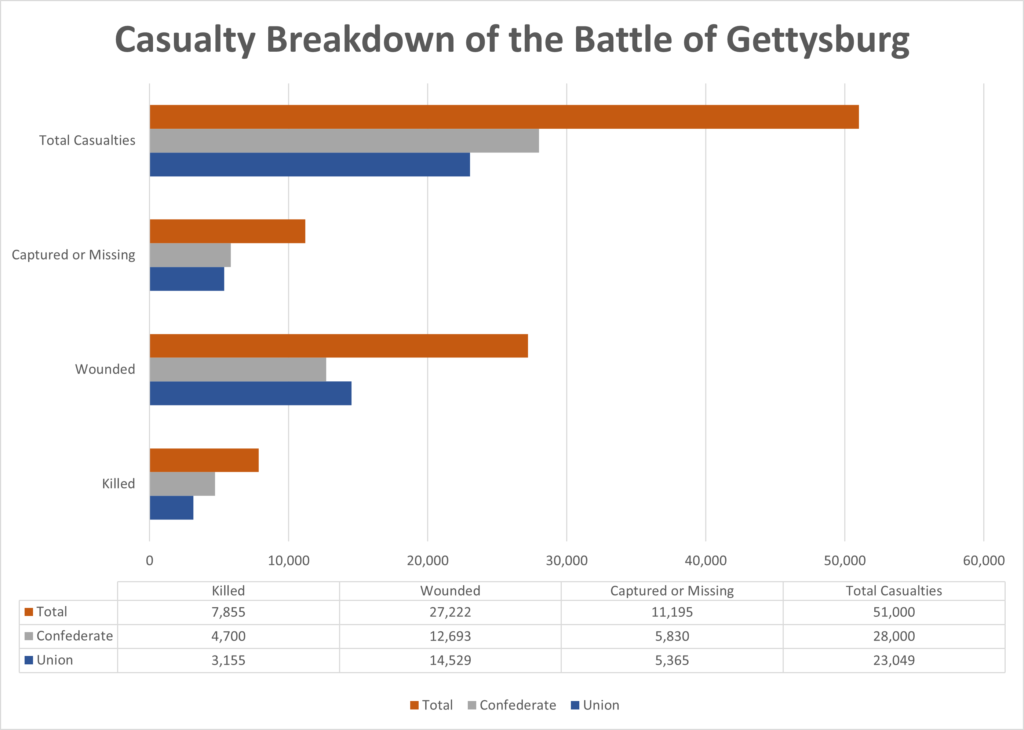
The Battle of Gettysburg resulted in approximately 51,000 total casualties. Here’s a more detailed breakdown of these figures:
- Union Casualties:
- Killed: 3,155
- Wounded: 14,529
- Captured or Missing: 5,365
- Total Union Casualties: 23,049
- Confederate Casualties:
- Killed: 4,700
- Wounded: 12,693
- Captured or Missing: 5,830
- Total Confederate Casualties: 28,000
This breakdown highlights that out of the 7,855 total soldiers killed, a substantial number were wounded (approximately 27,222), while 11,195 soldiers were captured or went missing. These figures illustrate the scale of suffering, revealing that the majority of casualties were injuries rather than deaths.
Common Misunderstandings
It’s important to clarify that the total casualty figure is often mistaken for the number killed. While the battle did result in a tragic loss of life, the majority of soldiers survived, albeit with serious wounds. Educators should emphasize these distinctions to help students understand the true toll of the battle.
Instructional Ideas for Cross-Curricular Math Lessons
Incorporating casualty data into math lessons offers students the opportunity to engage with historical figures analytically. Here are several instructional ideas:
- Data Analysis: Have students create pie charts to visually represent the proportions of killed, wounded, and captured. This activity reinforces concepts of data visualization and proportions.
- Percentages: Teach students how to calculate the percentages of each category. For instance:
- Killed: (7,855 / 51,000) × 100 ≈ 15.4%
- Wounded: (27,222 / 51,000) × 100 ≈ 53.4%
- Captured or Missing: (11,195 / 51,000) × 100 ≈ 22.0% This helps students understand the significance of each figure within the larger context.
- Estimations and Rounding: Have students estimate total casualties based on given percentages or approximate figures, and then compare these estimates to the actual data. This reinforces skills in estimation and rounding.
- Historical Comparisons: Introduce casualty figures from other Civil War battles, allowing students to compare and contrast. For example, comparing Gettysburg’s casualties with those at Antietam can lead to discussions about changing battle tactics and the nature of warfare.
Conclusion
A comprehensive understanding of the casualties at Gettysburg requires an analysis of the numbers beyond just the fatalities. By clarifying misconceptions and incorporating mathematical analysis into lessons, educators can foster a deeper appreciation for this critical event in American history, encouraging students to engage meaningfully with both the statistics and the human stories behind them.


The Confederate casualty numbers do not add up. The total by addition is 23000, not 28000.
It is all just a guess. So many of the missing were unaccounted for and presumed dead. So many of the wounded and captured later died in custody for both sides. Poor records were kept of all. So many were buried in mass graves at all battlefields. It was all a hideous mess.