
If the 12-pounder Model 1857 Napoleon Gun-Howitzer was the premier smoothbore artillery piece used during the American Civil War, the 3″ Ordnance Rifle was the most widely used rifled artillery piece. Another common rifled piece was the 10-pound Parrott Rifle. It can be distinguished from the Ordnance Rifle by a reinforcing “breech-band” at the breech end of the tube.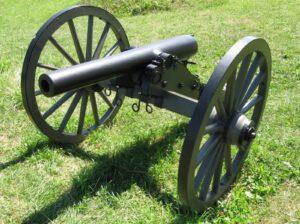
Key performance specifications:
- Caliber: 3 inches – Weight: 1,720 pounds – gun and carriage (780 kg)
- Length: 69 inches (1.75 m)
- Range: Up to 1,800 yards (1,646 meters)
- Muzzle Velocity: Approximately 1,400 feet per second (427 meters per second)
- Rate of Fire: Approximately 2-3 rounds per minute; Crew: 6-8 men
- Ammunition: Shot and shell weighing between 9 and 10 pounds (4-4.5 kg)
The 3″ Ordnance Rifle was highly regarded for its accuracy, range, and reliability. It was a rifled gun, meaning that it had spiral grooves inside the barrel that imparted spin to the projectile, resulting in greater accuracy and range than smoothbore guns of similar caliber. The gun was commonly used by both Union and Confederate forces during the Civil War, and it remained in service with the U.S. Army until the late 1800s. T
The most common types of ammunition used by the 3” Ordnance Rifle
- Solid shot: This was a heavy, solid iron elongated “bolt” that was used for long-range, direct fire against enemy fortifications or other hard targets. The effective range for solid shot was up to 1,800 yards but its use was rare.
- Shell: This was a hollow iron projectile filled with explosive powder and fitted with a fuse. When fired, the fuse was timed to ignite the powder and cause the shell to explode, showering the target with shrapnel. The effective range for shell was up to 1,600 yards.
- Case shot: This was a hollow iron projectile filled with small iron balls, which were designed to scatter upon firing and create a deadly cloud of shrapnel. The effective range for case shot was up to 800 yards.
- Canister: This was a tin or iron container filled with small iron balls or musket balls. When fired, the canister would open up and scatter the balls in a cone-shaped pattern, creating a deadly hail of fire against enemy troops at close range. The effective range for canister was up to 500 yards. (Because of the rifling and smaller bore, the use of canister in a rifle was much less effective than in a smoothbore at close range).
- Grapeshot: Although grapeshot could be used, it was rarely used in the field during the Civil War.
It’s worth noting that the effective range of each type of ammunition depended on a number of factors, including the elevation of the gun, the charge used, the weather conditions, and the skill of the gun crew. However, these ranges provide a general idea of the capabilities of the Ordnance Rifle and its ammunition.
The 3” Ordnance Rifle Using Canister
The size of the canister shot used by the 3″ Ordnance Rifle during the Civil War was approximately .58 caliber or about 0.58 inches in diameter. The canister was a tin or iron container that was filled with iron balls, usually around 70 to 80 in number, and was designed to be fired at close range against enemy troops. When fired, the canister would open up and scatter the iron balls in a cone-shaped pattern, creating a deadly hail of fire against the enemy.
Canister shot was particularly effective at short ranges, up to around 500 yards, and was often used in defense of artillery positions or to repel infantry assaults. While the number of balls in the Ordnance Rifle’s canister was greater than that of the Napoleon, the overall weight and density of the canister shot was less due to the smaller size of the Ordnance Rifle’s bore.


0 Comments