
 Samuel Abbott Cooley, born on November 3, 1821, in Hartford, Connecticut, was a pioneering figure in Civil War photography. As the eldest child of Dr. Abiel Abbott Cooley and Lucretia Hurlbert Cooley, Samuel’s early life was shaped by his family’s support and the vibrant community of Hartford. He married Emma Bell, and together they had a daughter, Anna Marietta.
Though specific details about Cooley’s education and professional training are sparse, his journey into the world of photography began in Beaufort, South Carolina. There, he and his family settled, and he operated a store with an upper-floor photography studio. This setup would soon prove invaluable.
The onset of the Civil War brought significant change. In the fall of 1861, Union forces captured Beaufort during the Battle of Port Royal. Armed with a heavy camera and plate-holder, Cooley seized the opportunity to document the war’s early stages. His dedication to capturing the conflict extended as he joined the U.S. Army’s X (Tenth) Corps, bringing along a wagon filled with equipment, chemicals, and fragile glass plates. Adapting to the field conditions, Cooley learned to handle the extreme heat and cold to produce quality images under challenging circumstances.
As the official photographer for the U.S. Army’s Department of the South, Cooley’s work was groundbreaking. He became the first photographer to document the buildings he encountered, contributing significantly to historic preservation. By May 1864, he sold his studio, intending to move his family back North. However, the war’s demands led him to chronicling battles like those involving the 70th Ohio Infantry and the 55th Illinois Infantry at the Battle of Fort McAllister. His travels took him through Hilton Head, St. Augustine, Jackson, Charleston, and Savannah, producing over 2,000 negatives.
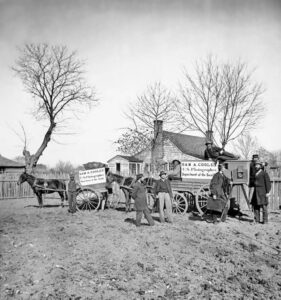 this period, Cooley partnered briefly with Isaac Becket, operating small galleries in Beaufort, Hilton Head, and Savannah. By 1865, Cooley marketed himself as the “Photographer Dept. of the South,” selling his combat and architectural photographs to both individuals and military officials, generating significant income.
After the war, Cooley’s C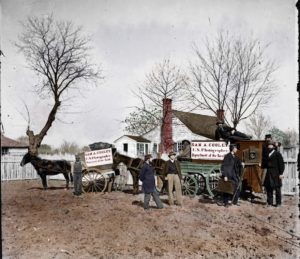 ivil War photographs earned him local notoriety and a prominent position in civic life. He became a successful auctioneer and served as sheriff of Beaufort. Returning to Hartford in 1869, he continued to sell and exhibit his Civil War photographs, including “Stereopticon Views,” which captivated audiences.
Samuel Abbott Cooley passed away on May 14/15, 1900, at the age of 78, and was buried in Hartford’s Old North Cemetery. Today, his legacy lives on through hundreds of his glass-plate negatives held by the Western Reserve Historical Society in Cleveland, Ohio, and numerous photographs preserved in public and private collections throughout the South.
Cooley’s work provides a vivid window into the Civil War era, capturing not just the conflict but also the architectural and human landscape of the time. His contributions to photography and historic preservation remain a valuable part of our understanding of American history.
0 Comments