
Even though embalming has been a common practice since the time of ancient Egypt, it did not become popular in the United States until the Civil War. There was a need to preserve their remains for the voyage because so many troops died distant from their homes and their families typically wanted them buried at home.
Thomas Holmes, who is known as the “Father of Modern Embalming” was born in New York City, in 1817. He developed an interest in medicine during his boyhood, and although historical records are sketchy and lacking, it is generally accepted that he received his degree from Columbia University’s College of Physicians and Surgeons in 1845. Afterward, he would work in the coroner’s office in New York City where he expanded on the French’s early modern vascular embalming methods. By the start of the Civil War, he had created a poison-free, safe embalming fluid that was marketed to several surgeons, doctors, and funeral directors across the nation.
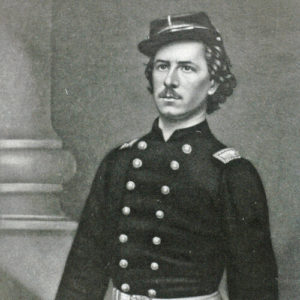 On the morning of May 24, 1861, while attempting to take down a Confederate flag in Alexandria, Virginia, Colonel Elmer E. Ellsworth was shot and murdered by innkeeper James Jackson. Ellsworth was a former legal clerk in Abraham Lincoln’s Springfield office who had also founded Zouave regiments in Chicago and New York. President Lincoln was inconsolable and requested that the Zouaves bring the body to the White House for the funeral. Holmes had the good fortune to get approval to embalm the body thanks to Secretary of State William Seward’s intervention. With the embalming of Ellsworth, Holmes’ reputation as an undertaker rose dramatically.
As a result of the positive coverage Ellsworth’s funeral received in Washington newspapers, Holmes’ standing as a successful embalmer and undertaker in the capital city was cemented. As the war went on and the number of wounded increased, Holmes’ skills were in high demand.
Holmes’ daily activities grew significantly thanks to his own efforts as well as those of other undertakers and aspiring embalming surgeons he had educated. The majority of morticians at the time were taught how to use his embalming tools and to buy his embalming fluid at $3 a gallon. The embalming process back then involved a wide range of various solutions. These solutions frequently contained varied mixtures of arsenic, creosote, mercury, turpentine, and alcohol. These substances may be dangerous for embalmers even when they are efficient for embalming.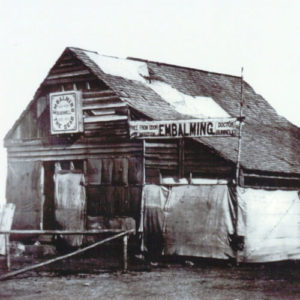
Most morticians also worked as cabinetmakers or furniture makers which allowed them to make their own coffins which sold for $4 to $7 each. Embalmers enjoyed a successful business during the war. Early in the war, an officer’s embalming cost $50, while an enlisted man’s expense was $25. The cost was later raised to $80 and $30, respectively.
The need for embalming services grew as the Civil War went on, and more people realized they could become embalmers and earn a living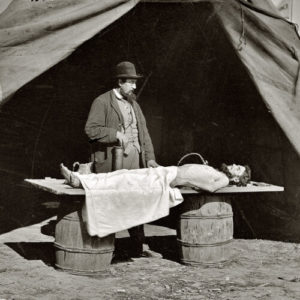 doing so. It was not good for morale when some embalmers would hang out around the camps and advertise their services. Others would look for the highest-ranked fallen officers on the battlefield in an effort to make money by getting in touch with their families and offering their services. Not all embalmers were honest. Many had a reputation for price gouging or even robbing dead and wounded soldiers. This became a significant enough concern that the War Department issued General Order Number 39, “Order Concerning Embalmers,” in March 1865. “All who embalm or remove the bodies of deceased officers or troops will receive special permission,” stated the directive. It also established the fees that embalmers could demand. Unfortunately, this command was given so late in the conflict that it had little impact.
Holmes kept on offering his services right up until the very end. The surgeon had embalmed some 4,000 soldiers by the time General Lee surrendered at Appomattox on April 9, 1865. Thomas Holmes had become a very wealthy and well-known man as a result of the war—or, more precisely, the awful death toll of the war. Ironically, Holmes asked that his own body not be embalmed before he passed away in 1900.


0 Comments