
Bread for an Army: The Capitol Bakery During the Civil War
When the Civil War began in April 1861, Washington, D.C., was suddenly overwhelmed. President Abraham Lincoln called for 75,000 volunteers to defend the Union, and within days thousands of soldiers from Pennsylvania, Massachusetts, and New York poured into the city. Housing them was difficult, and feeding them was even harder. With Congress out of session, the unfinished Capitol building became an improvised barracks. Soldiers slept in the Rotunda, drilled in the halls, and even swung on ropes tied to the dome’s scaffolding. The situation may have amused the soldiers, but it created a serious problem for those responsible for keeping the men fed. Out of that problem grew one of the most unusual wartime solutions: the Capitol Bakery.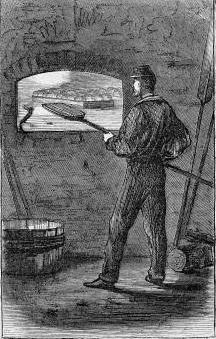
At first, soldiers from Massachusetts built two brick ovens in the basement to supply bread for the men staying inside the Capitol. Lieutenant Thomas J. Cate oversaw the work. The effort started small, but demand grew quickly. Within weeks, more ovens were added, until the basement of the Capitol was home to a massive bakery running day and night. By May 1861, it was turning out about 10,000 loaves a day.
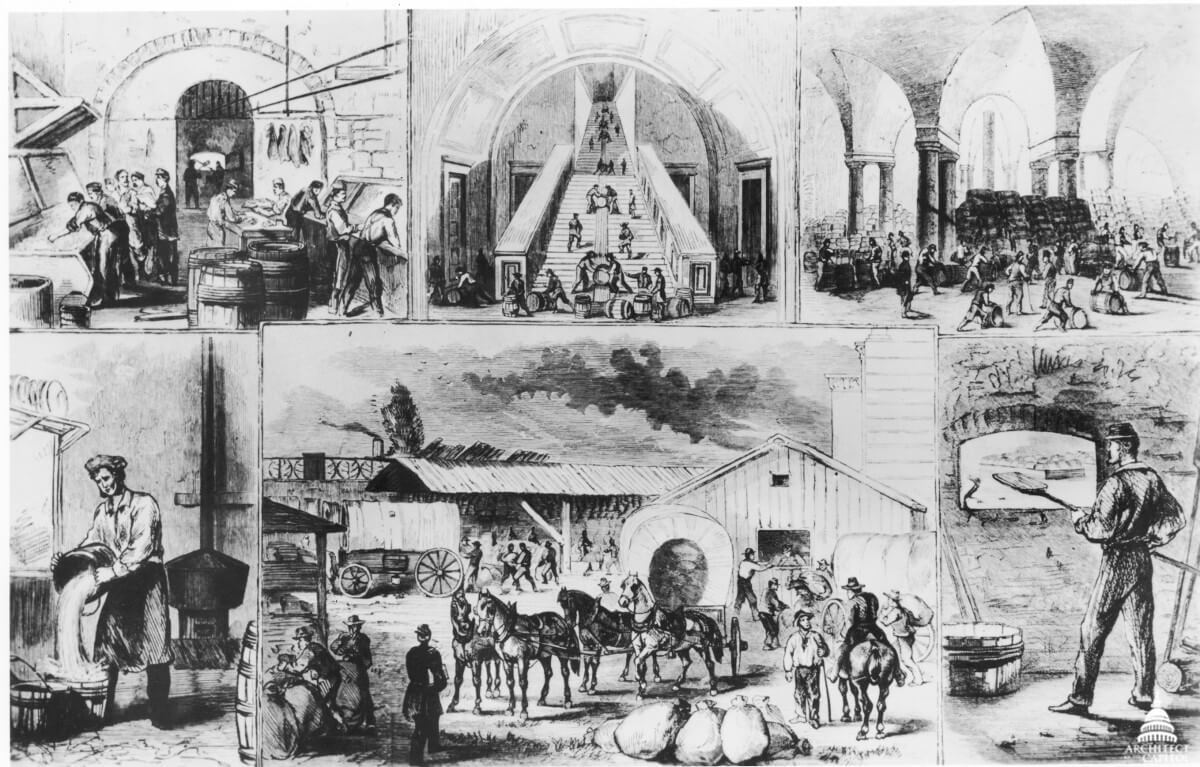
The process of baking on this scale was astonishing. Flour arrived from mills as far north as New York and was stored in the Capitol’s Crypt and its hallways. Barrels weighing nearly 200 pounds each were stacked high, sometimes reaching 20,000 barrels in a single month. When needed, workers rolled the barrels down wooden planks set over the marble stairs into the basement. There, three barrels at a time were mixed with water and yeast in long troughs. The yeast itself was made in a separate room, up to 1,400 gallons a day, much of it from potatoes. Once prepared, the dough was shaped into loaves and placed in large ovens, each able to hold hundreds at a time. The bread cooled on shelves for nearly a full day before it was loaded onto wagons through basement windows and carried to regiments across the city. By the time the operation shut down, the Capitol Bakery had produced more than ten million loaves of bread.
As important as the bakery was, it caused constant problems inside the Capitol. Black smoke drifted into the Senate chamber, making it impossible to heat the room without filling it with soot. The Library of Congress, located above the ovens, suffered even worse. Dust and smoke coated the books, leading the Librarian of Congress to warn that priceless volumes were being damaged beyond repair. Architect Thomas U. Walter, who was already frustrated that soldiers had interrupted his renovation work, found the noise, filth, and smell unbearable. Senators complained that their clothes reeked of smoke, and many demanded that the bakery be removed immediately.
The Army, however, argued that the Capitol was the only building in Washington with the gas lines and space required for such a large-scale operation. For more than a year, Congress debated whether to remove it. Finally, in the summer of 1862, President Lincoln authorized $8,000 to relocate the bakery and repair the damage it had caused. Within months, the ovens were dismantled, the smoke disappeared, and the Capitol returned to its intended purpose.
Despite the frustrations it caused, the Capitol Bakery played a critical role in feeding Union soldiers at a time when the survival of Washington, D.C. seemed uncertain. Its story shows how even the most symbolic building in the United States became a tool of war. For more than a year, visitors to the Capitol were not greeted by the usual sounds of debate or construction, but by the steady clatter of barrels and the smell of fresh bread baking for an army.
Classroom Activities
Discussion Questions
- Why do you think the Capitol was chosen as the site for a bakery?
- How would members of Congress have felt about sharing their building with soldiers and bakers?
- What does this story tell us about how war can change the use of public buildings?
Math Connection
- The bakery sometimes produced 60,000 loaves a day. Ask students to calculate how many loaves would be produced in a week or in a month. Compare that to how many loaves a single family might eat in a year.
Primary Source Exploration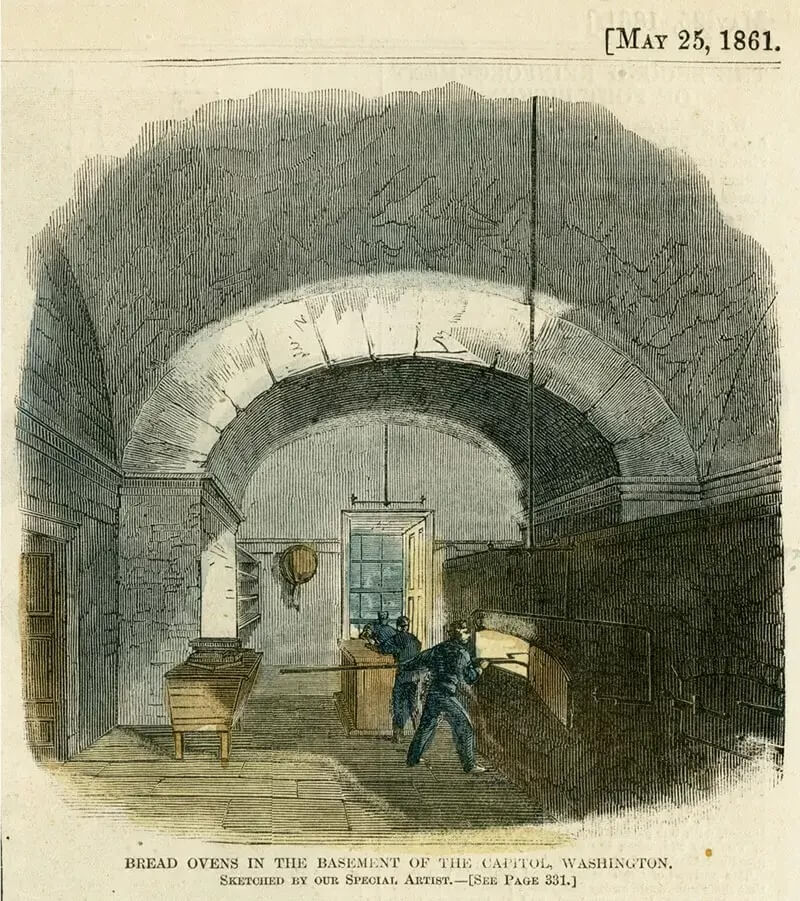
- Show students sketches of the bakery or soldiers in camp from the Library of Congress. Have them analyze what these photos reveal about the impact of the war on daily life in Washington.
- Librarian of Congress John G. Stephenson to write to Benjamin B. French, the Commissioner of Public Buildings, on October 14. Have students read the following and have them discuss ways to protect the Library:
“I am pained to see a treasure entrusted to my care – a treasure that money cannot replace – receiving great damage from the smoke and soot that penetrate everywhere through the part of the Capitol which is under my charge without any means at my command to prevent it. I am now satisfied that there is no remedy, except in the removal of the circle of bakeries that hems us in, and of those directly under the library.”
Writing Prompt
- Have students write a diary entry as a Union soldier staying in the Capitol. Encourage them to describe the smells, sounds, and sights of living in a building that was both a barracks and a bakery.


0 Comments