gettysburg

Teaching the Civil War Podcast Episode 11

by fifer1863 on December 21, 2011

Teaching the Civil War Podcast logo


Thanks for staying subscribed to my podcast and I hope you enjoy listening. In this episode I present a brief interview that I did with author JD Petruzzi.  I have done reviews of JD’s books here before and it was nice to talk to him in person about his works.

Feedback on the show? email me at podcast@teachthecivilwar.com

Follow Me on Twitter

Music is by Mark Ferguson and is used with permission.

Subscribe in iTunes

SHOW LINKS:

JD Petruzzi’s Website

Complete Gettysburg Guide Website

Gettysburg Campaign Handbook 

My Review of the Complete Gettysburg Guide


{ 0 comments }

Harper’s Weekly Online

by Jim on November 18, 2011

Ever wonder how newspapers during Civil War covered the battles? Are your doing any research into an aspect of the Civil War and need a great primary source? Well, the Son of the South website has digitized versions of Harper’s Weekly online for your review. According to the website, they have “over 7,000 pages of original Civil War content, and is full of incredible photographs, original illustrations, and eye-witness accounts of the defining moments of this Historic Struggle.” They have even organized the information based on each year of the war, different battles, generals, slavery, medicine and the Lincoln Assassination. How can you use this collection in your classroom?

  • Have students use this as research for a paper or report
  • Have students create their own newspaper with accounts of a battle
  • Have students read the July 18, 1863 and the “First Report from Gettysburg” and ask why did it take 17 days to get information out in the paper?
  • Have students review and reflect on the ads in the papers
  • Have students review and reflect on the cartoons in the paper and what impact they may have had on attitudes toward the War.
  • Check out the sketch of the Maryland Battery at Antietam, then have students research where the Maryland Battery was located at on the Antietam Battlefield. You may even want to contact an Antietam park Ranger or two? (talk about Subject Matter Experts!)

Let me know your thoughts on how you can use this great resource. Until next time…happy reading!

{ 0 comments }

The New Gettysburg Campaign Handbook Review

by fifer1863 on September 10, 2011

Recently, I received a copy of NEW GETTYSBURG CAMPAIGN HANDBOOK, THE: Facts, Photos, and Artwork for Readers of All Ages, June 9 – July 14, 1863 by J. D. Petruzzi and Steve Stanley.  Petruzzi is also the author of excellent book, The Complete Gettysburg Guide.

This 184 page handbook is packed full of facts, figures, photographs (both color and black/white), sketches, and the best part is the detailed maps by Steve Stanley. The book also contains, quotes, trivia, and an order of battle.  There are two special sections that I especially liked; one was “Gettsyburg on the Web” and the other was called “Gettysburg Bookshelf.”  There are sections on Gettysburg “Personalities”, Gettysburg Civilians and Visiting Gettysburg today.

According to the back cover this book “is an informative full-color guide for American Civil War and Gettysburg enthusiasts of all ages.  Authors J.David Petruzzi and Steven Stanley use clear and concise writing broken down into short and easy to understand chapter complete with original maps, modern and historic photographs, tables, and artwork to narrate the history of the Gettysburg Campaign from the opening battle at Brandy Station in Virginia on Jun 9, 1863, to the escape of General Robert E. Lee’s Confederate Army of Northern Virginia across the Potomac River on July 14, 1863.”

This handbook is a great quick reference guide for Gettysburg buffs of all ages and I’m sure it will be used by my son CJ for creating new videos.

I also asked the authors a few questions about the new book:

JIM: Mr. Stanley, how do you go about researching and creating your maps?

Steve Stanley:

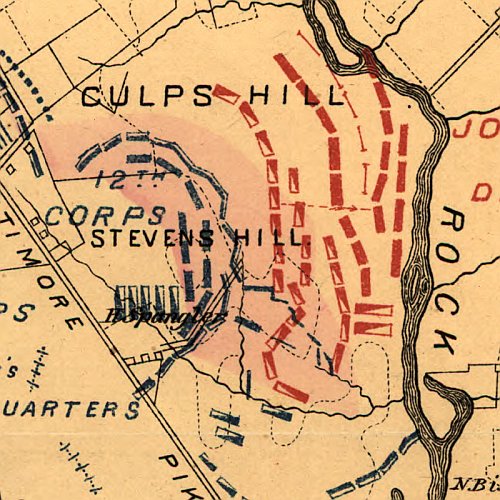
In creating and researching maps for this book or any other Civil War book/site, I like to go back as close as possible to the source for reference, i.e. in Gettysburg, the Bachelder maps were used as a starting point. Once I have found a map to work from, the fun begins. First I get that map into my computer (via scanning or in some cases downloading from Library of Congress) and set it up as it’s own layer in my drawing program. Once there I use it as a template. Then I start the creation of the base map itself. The different items are their own separate layer in the map file, i.e. topo lines, treeline, fence line, etc.
I always start off with the topographic line layer. Again using the historic map as a template, I completely redraw all the topographic following the topo lines on the template using my mouse as a drawing tool. After each individual line is drawn then I smooth that line out to get rid of the angular look. Depending on the size of the battlefield and the terrain of the region, drawing the topo lines can take anywhere from 2 to 48 manhours of drawing. The base topo map for Gettysburg took me about 36 manhours of drawing alone. Then I move onto and drawing in the historic roads, again using historic maps I draw in the historic roads that are still in use today and give them their own look. I then draw in the historic roads that are gone but still vital to the map and give them their own look (usually a dashed line). Next I will draw in the modern roads (if any) toned back so they are there but not overwhelming. The modern roads are for reference for the person using the map, to give them an idea of where they are located on the battlefield.
Next I will draw in the water features. I only indicate the historic water features on my maps. Then I move onto the historic structures and fencelines. Using historic maps I can add these features in their proper location, I was lucky with my Gettysburg maps in that I obtained a copy of the historic treeline and fenceline study done by the National Park Service here in Gettysburg. I was able to use that study to properly mark the battlefield. Then I start adding in the treelines. For Gettysburg, I was able to use the Treeline and fenceline study to place in the trees and orchards. Most battlefields I am not so lucky. Most of my treelines are an approximation of what was there during the battle but pretty close. Depending on the battlefield, I was able to use maps drawn by others (either historic or modern) to get me in the ballpark, then I would start reading narratives to see how they describe the trees and start adding in the trees.
After I have my basemap complete, I can now move onto the actual troop movements. First I have decide how much of the fighting I want to show on that particular map, i.e. just a small window of time, like in the Complete Gettysburg Guide or an entire battle on one map like I do for the Civil War Trust.  Again referencing historic battlemaps, I get my starting point. I also will look over other map makers work to get me in the ballpark of placing them. Once I have my starting point, then onto the Official Records and read how each individual unit moved, who was beside them, who fell back first or last and so on. I will also pull up contemporary writings and read through their narratives to get more precise. For the Complete Gettysburg Guide and the Handbook maps, I reference Harry Pfanz’s work, Trudeau’s Gettysburg, Wert’s Gettysburg Day Three and so many others they are too many to name. After I have what I feel is a complete map, I will find one of the historians for that battle to look it over for me and give me feedback. After changing the map to reflect those comments, it is ready for publishing. Sometimes things/mistakes slip through and over the past two years, I have corrected/changed a few of the maps in the Guide and because of that, the Handbook has some of the most accurate and up-to-date maps in them.
JIM: Mr. Petruzzi, your Complete Gettysburg Guide book is an excellent resource for learning about the battle, what makes your new book different from your original Guide?
J.D. Petruzzi:
Thank you!  Well, this Gettysburg Campaign Handbook addresses the entirety of the campaign.  The centerpiece is a photographic study of many actions and movements from the June 9, 1863 Battle of Brandy Station all the way to the crossing of the Potomac by Lee’s army on July 14 after the main battle.  As regards Gettysburg itself, many interesting items that wouldn’t fit into the Guide are now in this book – things such as the Medal of Honor awardees, the weather during the battle, capsule biographies, trivia, participant quotes, and the most up to date and comprehensive Gettysburg Order of Battle ever produced.
JIM: Mr. Petruzzi, as an author, historian and researcher, what are some of your favorite places to locate primary resources about the Battle of Gettysburg?

J.D. Petruzzi:
I very much enjoy getting material from the National Archives and the Library of Congress. Repositories such as the Gettysburg National Military Park research room, university libraries around the country, historical societies, and the US Army History Center in Carlisle PA are goldmines of primary source material.  I also love to read soldier letters – particularly those sent to me by descendants and which has never been used by authors before.  One of the best resources, I’ve found, are newspapers.  Not just the National Tribune or well known post-war southern papers, but the thousands of small-town newpapers that can be searched on the Library of Congress website.  It’s in those that many interesting tidbits pop up.
JIM: In researching your book, what is one thing that you learned that surprised you or dispelled a myth that you thought was true?

J.D. Petruzzi:
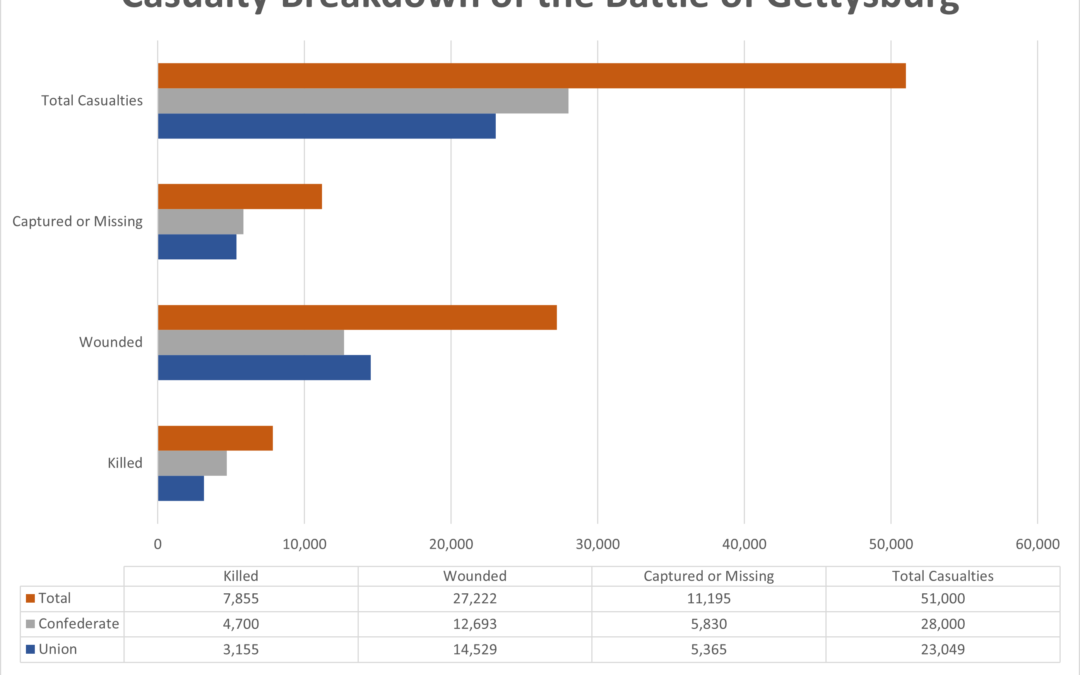
I was actually quite surprised by the number of casualties suffered by both armies during the entirety of the campaign – much higher than I would have guessed.  I found that in researching the Order of Battle… but those casualty figures aren’t in this Handbook.  That information is coming in our next one, titled The Gettysburg Campaign in Numbers and Losses, set for release in the spring of 2012.  Stay tuned for that one!

Paperback: 184 pages

Publisher: Savas Beatie; 1st edition (July 2011)

Language: English

ISBN-10: 161121078X

ISBN-13: 978-1611210781

Dimensions: 9.1 x 6 x 0.2 inches


{ 0 comments }

Gettysburg’s Eternal Peace Light Memorial with CJ

July 16, 2011

Here is a video of my son CJ teaching us about one of the more popular sites in Gettysburg, the Eternal Peace Light Memorial.  This monument is located on Oak Hill in Gettysburg.  Confederate forces marched toward Gettysburg and the Union lines from behind the monument where CJ is sitting.   The base relief is said [...]

Read the full article →

Learning about the “Trough Rock” in Gettysburg with CJ

July 14, 2011

Here is a video of my son CJ teaching us about one of the less popular sites in Gettysburg known as the “Trough Rock”. This rock is located in the “Slaughter Pen” or “Valley of Death” near Devil’s Den.     Here is the photo of the horse drinking from the rock: Here is a [...]

Read the full article →

Teaching the Civil War Podcast Episode 3

June 18, 2011

      This is the third episode of my new podcast. I hope the quality is better (I’m still playing with the settings) and that you enjoy listening. In this episode I discuss a my upcoming ISTE presentation, a Civil War Reenactment, Civil War Sallie and a family trip to Gettysburg. Feedback on the [...]

Read the full article →

Unknown Graves in the Soldiers National Cemetery

June 5, 2011

Here is a video of my son Josh learning about the the 979 Unknown Soldier’s National Cemetery in Gettysburg     Sarah is reading from THE COMPLETE GETTYSBURG GUIDE by JD Petruzzi  

Read the full article →

Gettysburg Soldier’s National Cemetery

June 3, 2011

Here is a video of my daughter Sarah (aka @civilwarsallie) learning about the Soldier’s National Cemetery in Gettysburg     Sarah is reading from THE COMPLETE GETTYSBURG GUIDE by JD Petruzzi  

Read the full article →

Gettysburg Generals Hancock and Reynolds

June 1, 2011

Here is a video of my son CJ learning about the monuments to General Hancock and Reynolds in Gettysburg   CJ is reading from THE COMPLETE GETTYSBURG GUIDE by JD Petruzzi  

Read the full article →

History Channel Movie on Gettysburg

May 21, 2011

On Monday, May 30, 2011, the History Channel will air a new Civil War film on Gettysburg.  This film is produced by Tony and Ridley Scott.  The trailer for the movie looks good so this is something that I am looking forward to watching.  If you are teaching the Civil War at this time of [...]

Read the full article →